
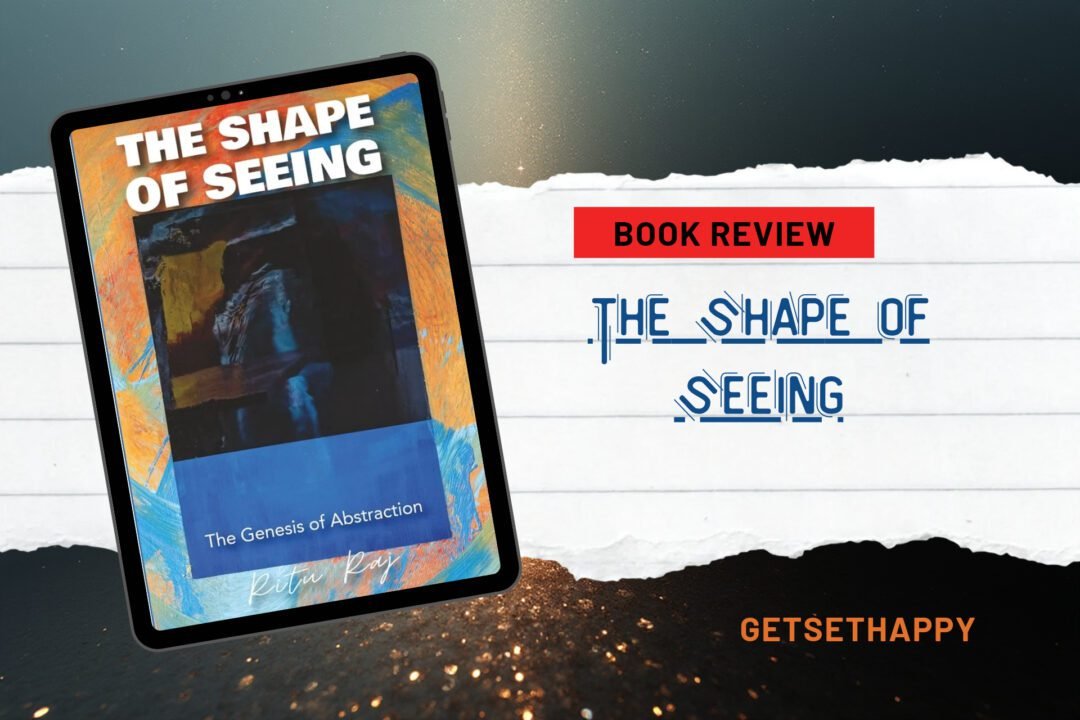
Have you ever stood in front of an abstract painting and wondered what you were supposed to see? I certainly have. Sometimes, I find myself looking at colours, lines and shapes, trying to connect them to something familiar. But what if the point isn’t to recognise anything at all? What if the beauty lies in simply experiencing what is in front of us?
That is one of the interesting questions I found myself thinking about while reading The Shape of Seeing: The Genesis of Abstraction by Ritu Raj. It is not just a book about painting. It is a personal exploration of creativity, perception, memory and the relationship between art and life.
A Personal Journey from Mathematics to Abstract Art
What immediately caught my attention was the author’s unconventional journey. Growing up in a home surrounded by art and literature, Ritu Raj was introduced to creativity at an early age. His father, K.B. Goel, was an eminent art critic, while his mother was a professor of English literature.
However, life took him in a different direction. With an education in mathematics and computer science, he spent more than three decades working in business and technology.
His return to painting during the pandemic in 2020 forms the emotional starting point of this book. What I found particularly interesting was how he describes this return, not as discovering something new, but as reconnecting with a part of himself that had always been there.
Sometimes, the things we leave behind are simply waiting for the right moment to find their way back.
Understanding Abstract Art Beyond Colours and Shapes
One of the strongest aspects of this book is the way Ritu Raj explains abstraction. He doesn’t treat it as something mysterious or complicated that only art experts can understand.
Instead, he encourages us to look beyond what is immediately visible.
Through chapters such as Why Abstraction, The Language of Color and Geometry of Emotion, he explores how colours, lines, empty spaces and movement can communicate feelings and experiences without necessarily representing recognisable objects.
I particularly enjoyed reading about his experimental painting technique involving a simple piece of string dipped in pigment and pulled across a surface. What began almost accidentally became an important part of his artistic language.
It is a lovely reminder that creativity doesn’t always come from having everything planned. Sometimes, allowing things to unfold can lead to the most interesting discoveries.
Where Mathematics, Technology and Creativity Meet
Another aspect I appreciated was the connection between seemingly different worlds.
Having spent years working with mathematics, computer science and technology, the author brings a unique perspective to his understanding of art. He sees patterns, structures, balance and relationships in much the same way a mathematician might approach an equation.
The chapters exploring the digital studio and the relationship between technology and artistic expression add another interesting dimension.
Rather than presenting technology and traditional art as opposing forces, he explores how both can coexist and influence one another.
I found this particularly refreshing because creativity is often associated with spontaneity, while technology is associated with logic and precision. This book makes an interesting case for bringing the two together.
A Book That Encourages You to Slow Down and Look Again
Beyond its exploration of art, I think the book has something meaningful to say about everyday life.
Themes of silence, attention, memory, time and transformation appear throughout the narrative. The author repeatedly returns to the importance of slowing down, observing carefully and allowing ourselves to experience things without immediately trying to define them.
And honestly, that is something many of us could use a little more of.
The writing is reflective and philosophical, with several passages that make you pause and think. It isn’t a fast-paced read, nor is it intended to be. Some ideas take time to settle, and I found that the best way to approach this book was to read a little, reflect and then move ahead.
Readers looking for practical painting lessons or a step-by-step guide to creating abstract art may find this different from what they expect. This is much more about the thinking, philosophy and personal experiences behind the artist’s work.
My Final Thoughts
The Shape of Seeing is a thoughtful and personal book that offers a different perspective on abstract art and the creative process. What makes it interesting is that it doesn’t limit itself to the world of painting. It connects art with science, technology, philosophy and the human experience.
I particularly liked the idea that seeing is not simply about looking at something but about being present enough to experience it.
If you enjoy art, creative thinking, philosophy or stories about rediscovering your passions, this book is worth exploring. Even if abstract art isn’t something you naturally gravitate towards, it might just encourage you to look at it differently.
And perhaps that is the real beauty of this book: sometimes, we don’t need to understand everything we see. We just need to learn how to see. Get your copy of The Shape of Seeing by Ritu Raj on Amazon.
There’s another amazing book by Ritu Raj – The Unalgorithmic Self, I am sure you don’t want to miss this one too.
About the Author
Ritu Raj was born in New Delhi, India, and has lived in San Francisco and Phoenix. Trained in mathematics and computer science, he spent over thirty years working in business and technology before returning to his first love, painting. Raised in a family deeply connected to art and literature, his work explores the intersection of abstraction, consciousness and time. His paintings have been exhibited in the United States and internationally. He currently lives and works in Phoenix, Arizona.



No Comments