
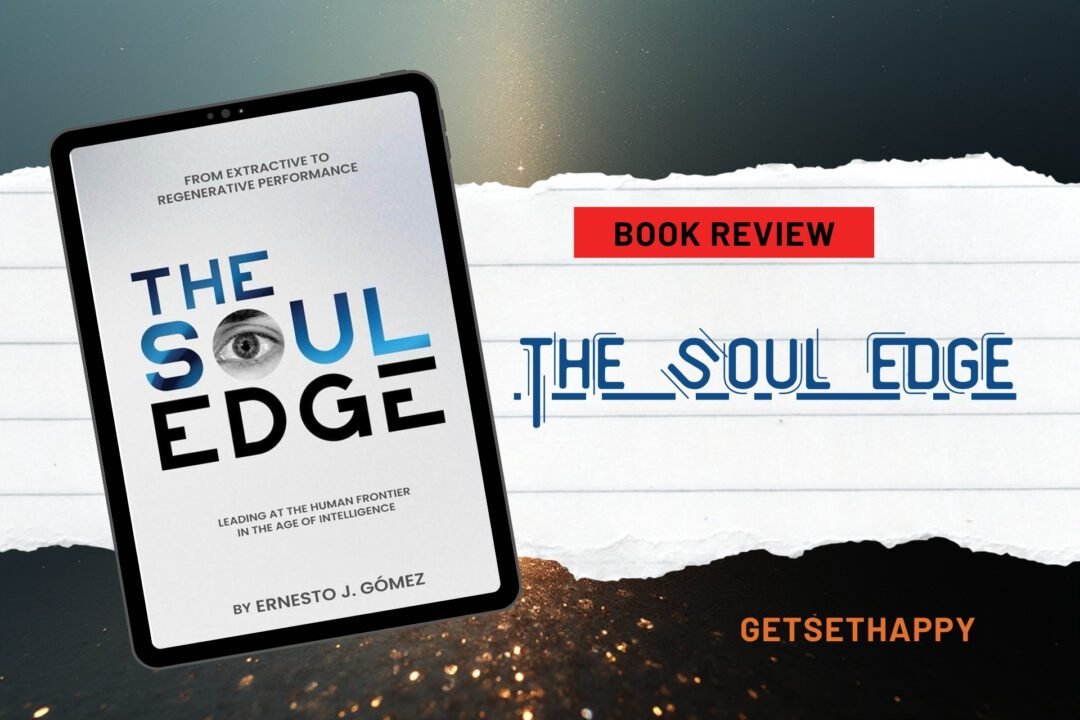
We have spent years being told to work harder, move faster, become more productive, and squeeze more out of every resource. But what happens when “more” finally stops working? The Soul Edge asks exactly that question. Set against the rapidly changing world of artificial intelligence, Ernesto J. Gómez argues that the next great advantage in leadership may not come from better technology or more knowledge, but from something technology cannot easily reproduce: our awareness, creativity, meaning, judgment, and humanity.
A New Approach to Leadership in the AI Age
What immediately caught my attention was the book’s challenge to the traditional idea of performance. Gómez describes the old model as extractive performance—a system built around control, intelligence, pressure, productivity, and output. It can certainly produce results, but when pushed too far, it can also drain the very people responsible for creating those results.
The alternative he proposes is regenerative performance. Instead of constantly taking energy from people, leaders should create conditions that renew human capacity. The goal is not simply to get more from employees, but to help people grow while producing sustainable results.
I found this idea particularly relevant because the arrival of AI makes the question even more urgent. If machines can increasingly handle knowledge, analysis, and repetitive work, what exactly remains uniquely human?
According to Gómez, quite a lot.
The Leadership Diamond Makes Things Practical
One of my favorite concepts in the book is The Leadership Diamond. Instead of suggesting that a good leader must always be decisive, confident, forceful, or inspiring, Gómez asks us to understand the opposite qualities too.
The model works around two pairs: Trait and Counter, and Push and Pull. A leader might naturally rely on decisiveness, for example, but sometimes the situation requires inquiry. Confidence may need humility. Drive may need patience. Similarly, Push can create action through authority and urgency, while Pull creates energy through trust and connection.
I liked this because it makes leadership feel less like following a fixed personality type and more like developing range. Sometimes you need to push. Sometimes you need to step back. The real skill is knowing which one the situation needs.
From Doing More to Doing Less, Better
Another section that stayed with me was the discussion around the “Do More with Less” trap.
We have all heard this phrase. Companies cut costs, reduce teams, increase targets, and expect the remaining people to somehow deliver more. The author argues that this approach eventually reaches diminishing returns. Productivity suffers, creativity disappears, and burnout becomes part of the system rather than an individual failure.
His answer is surprisingly simple: do an informed less, then do less better.
That doesn’t mean laziness or lowering standards. It means becoming more deliberate about what deserves our time and energy. Instead of constantly adding initiatives, priorities, meetings, and processes, leaders need the courage to remove what no longer matters. I found this one of the most practical ideas in the book.
The Soul Edge Is Really About Becoming More Human
At the heart of the book is Soul-Based Regenerative Leadership, which develops through four movements: Skills, Mindset, Essence, and Higher Field, all grounded in awareness. The journey moves from what we can do, to how we think, to who we are, and finally toward a sense of participation in something larger than ourselves.
The word “soul” might initially sound unusual in a business book. I had that reaction too. But Gómez isn’t using it simply as a synonym for company culture or employee morale. He uses it to describe the deeper inner coherence connecting what we do, how we think, who we are, and what gives our work meaning.
The Soul Edge isn’t a quick list of leadership hacks. It is more reflective than that. At times, the ideas are dense and require you to slow down, especially if you are more comfortable with conventional business language. But that is also part of its appeal.
I finished the book thinking that perhaps the future of leadership isn’t about becoming more efficient versions of ourselves. Perhaps it is about becoming more conscious ones. Grab your copy of the book on Amazon: The Soul Edge by Ernesto J. Gómez
About the Author
Ernesto J. Gómez began his career building food-service ventures across Mexico and the United States before moving into corporate leadership. He served as Vice President of Human Capital at Grupo ALFA, overseeing human-capital strategy across 83,000 employees in 32 countries, and later became Chief Human Resources Officer of Sigma Alimentos. He is the founder and CEO of Aspen Mindset1, where he works on what he calls Regenerative Performance. He is also the author of Regrowth: How Organizations Can Overcome Stalling by Unlocking Their People’s Potential. Gómez has completed executive education at institutions including Stanford GSB, MIT Sloan, Wharton, Harvard Business School, and several others, and has spoken at MIT Sloan on leading through ambiguity.


No Comments