
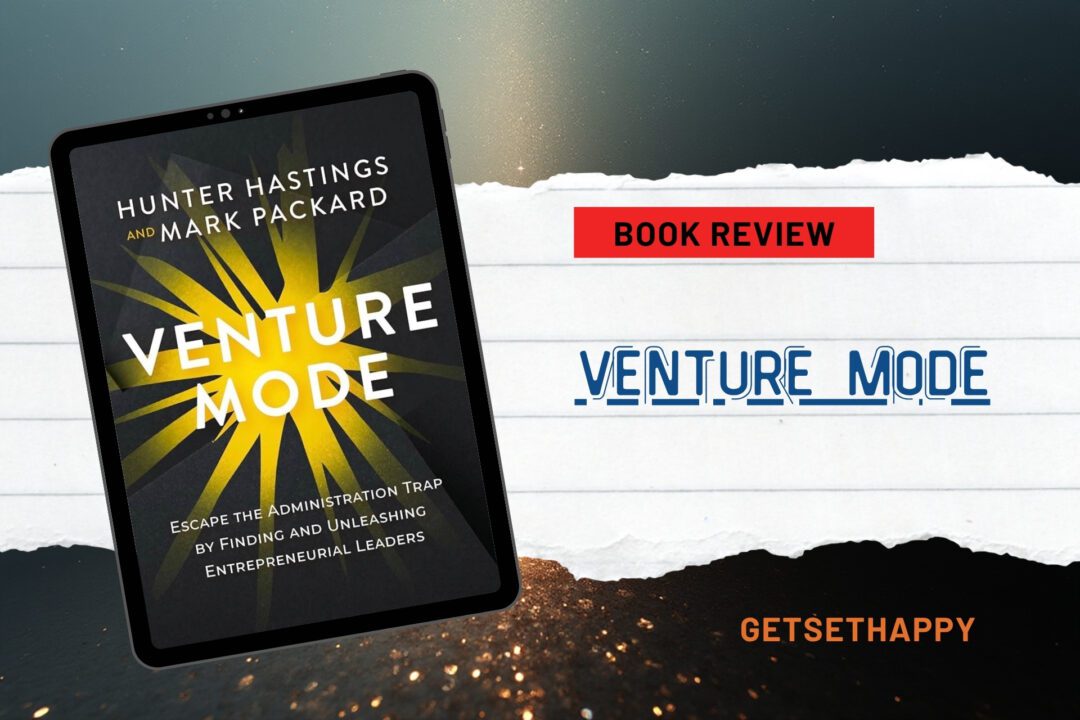
What if the biggest obstacle to innovation isn’t technology, competition, or lack of talent—but the way we run organizations? That question stayed in my mind throughout Venture Mode. This book isn’t afraid to challenge old ideas, and I found myself nodding along, disagreeing at times, and most importantly, thinking deeply about what modern leadership should really look like.
Written by Hunter Hastings and Mark Packard, Venture Mode: Escape the Administration Trap by Finding and Unleashing Entrepreneurial Leaders is not your typical business book. It doesn’t offer a list of management hacks or productivity tips. Instead, it makes a bold claim: businesses are suffering because they are run by administrators rather than entrepreneurs.
At first, I thought this argument sounded extreme. But as I moved from chapter to chapter, I began to understand where the authors were coming from. They believe modern organizations have become obsessed with processes, hierarchies, and efficiency while ignoring the one thing that truly matters—creating value for customers.
Why Venture Mode Challenges Traditional Business Thinking?

The central idea of the book is the difference between “administration mode” and “venture mode.”
Administration mode is the traditional approach. It focuses on rules, hierarchy, planning, and control. According to the authors, this is the mindset taught by most MBA programs and followed by many large organizations. While it may help companies stay organized, it often slows innovation and makes leaders more concerned with systems than with customers.
Venture mode offers a completely different perspective. It encourages leaders to think like entrepreneurs—to experiment, adapt quickly, understand customers deeply, and constantly search for new ways to create value.
I found this distinction surprisingly powerful. It explained why some companies remain innovative as they grow while others become slow, bureaucratic, and disconnected from the people they serve. The book argues that businesses shouldn’t switch off their entrepreneurial spirit just because they’ve become successful.
And honestly, I think there’s a lot of truth in that.
Entrepreneurial Leadership Over Bureaucratic Management
One of my favorite parts of Venture Mode is the discussion about leadership.
The authors believe great leaders are not distant executives who simply review reports and approve budgets. Instead, they stay connected to products, customers, and the details that matter most. They call this entrepreneurial leadership, and they believe it is the key to long-term success.
Throughout the book, they use examples of leaders such as Steve Jobs, Elon Musk, Brian Chesky, and Tony Fadell. These are people who remained deeply involved in their companies instead of relying entirely on layers of management.
I especially enjoyed the section on Airbnb CEO Brian Chesky. His belief that leaders should stay close to the details of their business challenges the traditional idea that executives should always step back and delegate everything.
Reading this made me rethink the difference between leadership and management. The book argues that businesses need more creators, builders, and visionaries—and fewer administrators obsessed with processes.
That may sound controversial, but the authors make their case with confidence and plenty of examples.
The Real Meaning of Value Creation in Business
Another theme that stood out to me was the idea of value creation.
The authors repeatedly remind readers that businesses don’t exist simply to maximize profits. They exist to create something valuable for people. Revenue and profits are important, but they are outcomes—not the starting point.
I liked this approach because it feels refreshingly human.
So many business books focus on metrics and strategies that they forget the people behind those numbers. Venture Mode keeps bringing the conversation back to customers—their needs, emotions, and experiences.
The authors argue that companies become successful when they obsess over solving problems and improving lives. They believe leaders should spend less time protecting systems and more time understanding what customers truly want.
I found this perspective inspiring because it shifts the focus from maintaining the status quo to constantly creating something better.
Is Venture Mode Worth Reading?
Without a doubt, yes.
I think Venture Mode is one of those books that will appeal to entrepreneurs, business students, founders, and even experienced managers who feel frustrated by bureaucracy and slow decision-making.
What I appreciated most is that the book doesn’t just criticize existing systems. It offers a new vision—one where leadership is built on creativity, empathy, adaptability, and value creation.
Will everyone agree with the authors? Probably not. Their opinions are strong, and at times their criticism of business schools feels uncompromising. But that’s also what makes the book interesting. It challenges readers to think differently, and I always appreciate books that leave me with more questions than answers.
I finished Venture Mode feeling energized and curious. It made me wonder how many organizations are limiting themselves simply because they’re afraid to think like entrepreneurs. And if a book can change the way I look at leadership, even a little, I think it’s worth reading. The book is available for purchase on Amazon: Venture Mode by Hunter Hastings & Mark Packard.
You may like to read another book by Hunter Hastings – The Post-Managerial Era of Capitalism by Hunter Hastings.
About the Author
Venture Mode is written by Hunter Hastings and Mark Packard. Hunter Hastings is an entrepreneur, former Silicon Valley start-up CEO, and venture capital professional with decades of experience in value creation and brand building. Mark Packard is an associate professor of management at Florida Atlantic University whose research focuses on entrepreneurship, innovation, and value creation. Together, they combine practical experience and academic insight to present a bold vision of entrepreneurial leadership and the future of business.



No Comments